Industrial Induction Heating Systems
Designed for labs, production lines, and technical teams who demand control, efficiency, and results.
Our proprietary megahertz technology delivers precision heating calibrated to your exact project and process requirements.
Most induction systems stop short of MHz frequencies, while Himmelwerk goes up to 3 MHz. Providing unmatched surface-level control and responsiveness.
Ideal for R&D, universities, and test benches.
Perfect for automated systems, production cells, and scalable heating requirements.
Great for sensitive materials, cleanroom processes, and high-repeatability applications.
Himmelwerk designs each system around material, temperature, and production requirements
Tell us about your material, heating target, and process. We’ll conclude a team based assessment of your material, temperature goals, and process to recommend the ideal approach.
Medium frequency
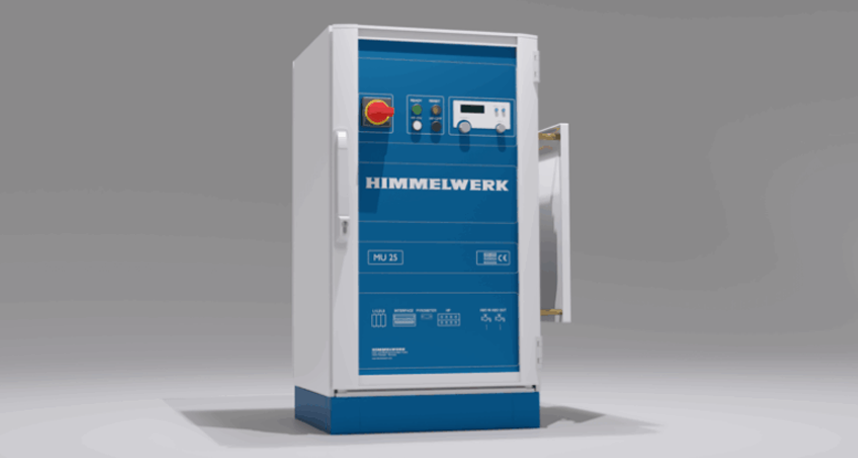
MU series up to 250 kW
MU R series from 10 kW
Inductors
Inductors & External Circuits
Measurement & Monitoring Technology
Spectral Pyrometer
Smart Upgrade
Further induction technology
Cooling Water Recooling Systems
Melting plants
Seit 1950 wurden von Himmelwerk 19.000 Hochfrequenz- und Mittelfrequenzgeneratoren in alle Welt verschickt.
Wie viel CO₂ sparen sie eigentlich pro Jahr ein? Eine Rechnung.
Annahme 1: 25 % der Generatoren sind noch in Betrieb.
Annahme 2: Sie haben im Durchschnitt eine Leistung von 6 kW und damit eine Leistungsaufnahme von 7 kW.
Annahme 3: Die Generatoren sind 8 Stunden/Tag und 5 Tage/Woche in Betrieb.
Annahme 4: Induktive Erwärmung spart bis zu 40 % Energie ein im Vergleich zu konventionellen Methoden. Gehen wir mal von 30 % aus.
Bei diesen Annahmen sieht die Rechnung so aus:
Täglicher Energieverbrauch: 8 h x 7 kW = 56 kW
Energieersparnis am Tag: 56 kWh / 0,7 = 80 kWh; 80 – 56 = 24 kWh
Gesamtersparnis am Tag: 24 kWh x 4.750 Generatoren = 114.000 kWh
Gesamtersparnis pro Jahr: 220 Arbeitstage x 114.000 kWh = 25.080.000 kWh
Umrechnungsfaktor kWh/CO₂: 1 kWh ≈ CO₂-Äquivalenzwert von 0,485 kg Strom (Quelle: Umweltbundesamt, Climate Change 15/2022)
CO₂-Einsparung pro Jahr: 25.080.000 kWh x 0,485 kg = 12.163.800 kg