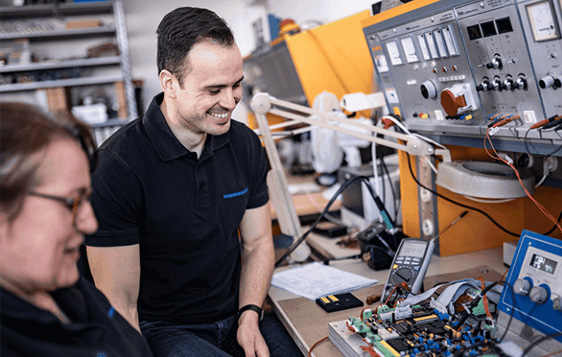
Himmelwerk is the industry leader in MHz heating solutions giving you the ability to heat small components, sensitive materials, and surface-level areas with unmatched precision.
What MHZ Heating Enables:
Surface-level accuracy with minimized thermal spread
Cleaner heating environments with lower oxidation
Faster cycles with consistent, repeatable results
Better measurement and traceability of heat and power
We Build MHz Systems Around Your Material, Geometry & Process Requirements.
Not Sure Which Model Fits Your Application?
Our technical team will review your heating target, application, and production goals, then recommend the ideal system. This way you are ensured to get the exact system needed to attain the desired results.
Himmelwerk designs each system around material, temperature, and production requirements
Soldering & brazing
Bonding & micro-assembly
Shrink Fitting
Thermal Testing
Prototyping
Cleanroom & Lab Processes
Start Your Project
Tell us about your material, heating target, and process. We’ll conclude a team based assessment of your material, temperature goals, and process to recommend the ideal approach.
Seit 1950 wurden von Himmelwerk 19.000 Hochfrequenz- und Mittelfrequenzgeneratoren in alle Welt verschickt. Wie viel CO₂ sparen sie eigentlich pro Jahr ein? Eine Rechnung.
Annahme 1: 25 % der Generatoren sind noch in Betrieb.
Annahme 2: Sie haben im Durchschnitt eine Leistung von 6 kW und damit eine Leistungsaufnahme von 7 kW.
Annahme 3: Die Generatoren sind 8 Stunden/Tag und 5 Tage/Woche in Betrieb.
Annahme 4: Induktive Erwärmung spart bis zu 40 % Energie ein im Vergleich zu konventionellen Methoden. Gehen wir mal von 30 % aus.