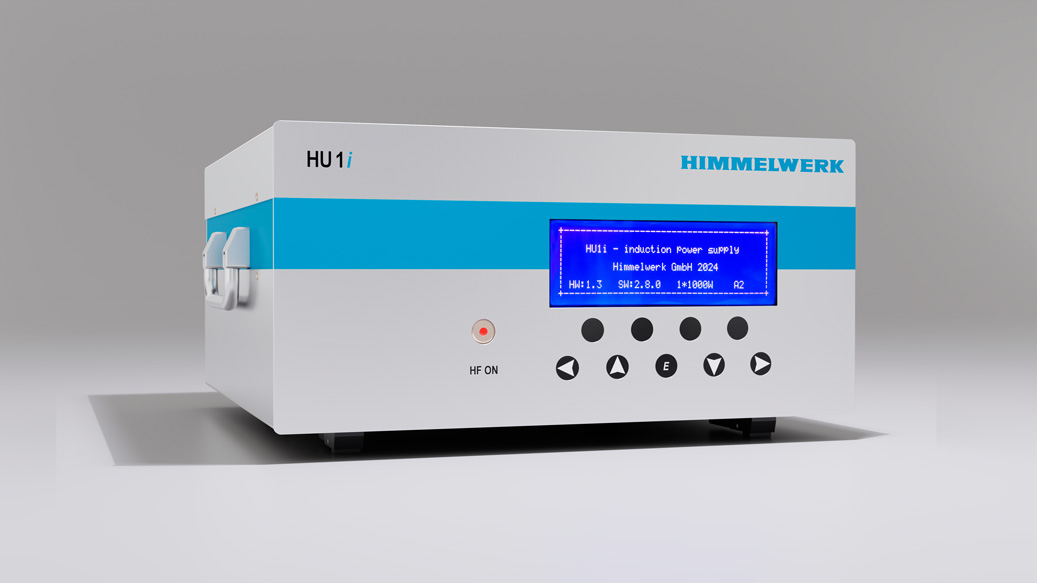
HU 1i

Our high-frequency generator HU 1i delivers minimal heat penetration thanks to its frequency range of up to 3.0 MHz.

It enables precise and repeatable parameter control and integrates seamlessly into any production workflow. Microprocessor-controlled, the HU 1i is ideal for heating extremely thin materials in processes such as coating, stress relief, or soldering.

The HU 1i is perfectly suited for submillimeter workpieces like medical needles, stent implants, or for the production of battery foils.

Boost your production’s energy efficiency. Lead the market. With cutting-edge technology for micro components. Get in touch with us!

Technical benefits

  • Improved networking possibilities through industrial interfaces
  • Curve evaluation via fast control with cycle times of 1 ms
  • Optional addition of data logger
  • Optional addition of various bus systems
  • Further technical benefits of the HU series
  • Device protection class IP54

Himmelwerk IOT

Our converters learn along with us

Industry IoT is still the current challenge of our time. Induction IoT is how we respond to this. The opportunities of digitalisation inspire us, because they can help make induction heating even more sustainable and forward-looking.

give us a call

Seit 1950 wurden von Himmelwerk 19.000 Hochfrequenz- und Mittelfrequenzgeneratoren in alle Welt verschickt.
Wie viel CO₂ sparen sie eigentlich pro Jahr ein? Eine Rechnung.

Annahme 1: 25 % der Generatoren sind noch in Betrieb.

Annahme 2: Sie haben im Durchschnitt eine Leistung von 6 kW und damit eine Leistungsaufnahme von 7 kW.

Annahme 3: Die Generatoren sind 8 Stunden/Tag und 5 Tage/Woche in Betrieb.

Annahme 4: Induktive Erwärmung spart bis zu 40 % Energie ein im Vergleich zu konventionellen Methoden. Gehen wir mal von 30 % aus.

Bei diesen Annahmen sieht die Rechnung so aus:

Täglicher Energieverbrauch: 8 h x 7 kW = 56 kW

Energieersparnis am Tag: 56 kWh / 0,7 = 80 kWh; 80 – 56 = 24 kWh

Gesamtersparnis am Tag: 24 kWh x 4.750 Generatoren = 114.000 kWh

Gesamtersparnis pro Jahr: 220 Arbeitstage x 114.000 kWh = 25.080.000 kWh

Umrechnungsfaktor kWh/CO₂: 1 kWh ≈ CO₂-Äquivalenzwert von 0,485 kg Strom (Quelle: Umweltbundesamt, Climate Change 15/2022)

CO₂-Einsparung pro Jahr: 25.080.000 kWh x 0,485 kg = 12.163.800 kg