Smart Upgrade auf Umrichter in Werkshalle

Smart Upgrade

More efficiency, faster cycle times, less waste – all this is guaranteed by the Smart Upgrade, with which you upgrade quality assurance for your induction.

With the Smart Upgrade, you monitor the induction heating processes. In self-learning mode, the module first evaluates the recorded data, after which the exact limit values are activated on request. All production processes which exceed these values are then stopped automatically or trigger warning messages. The sources of errors can be eliminated immediately without unnecessary rejects.

Many transistor-based Himmelwerk frequency converters can be upgraded with the Smart Upgrade.
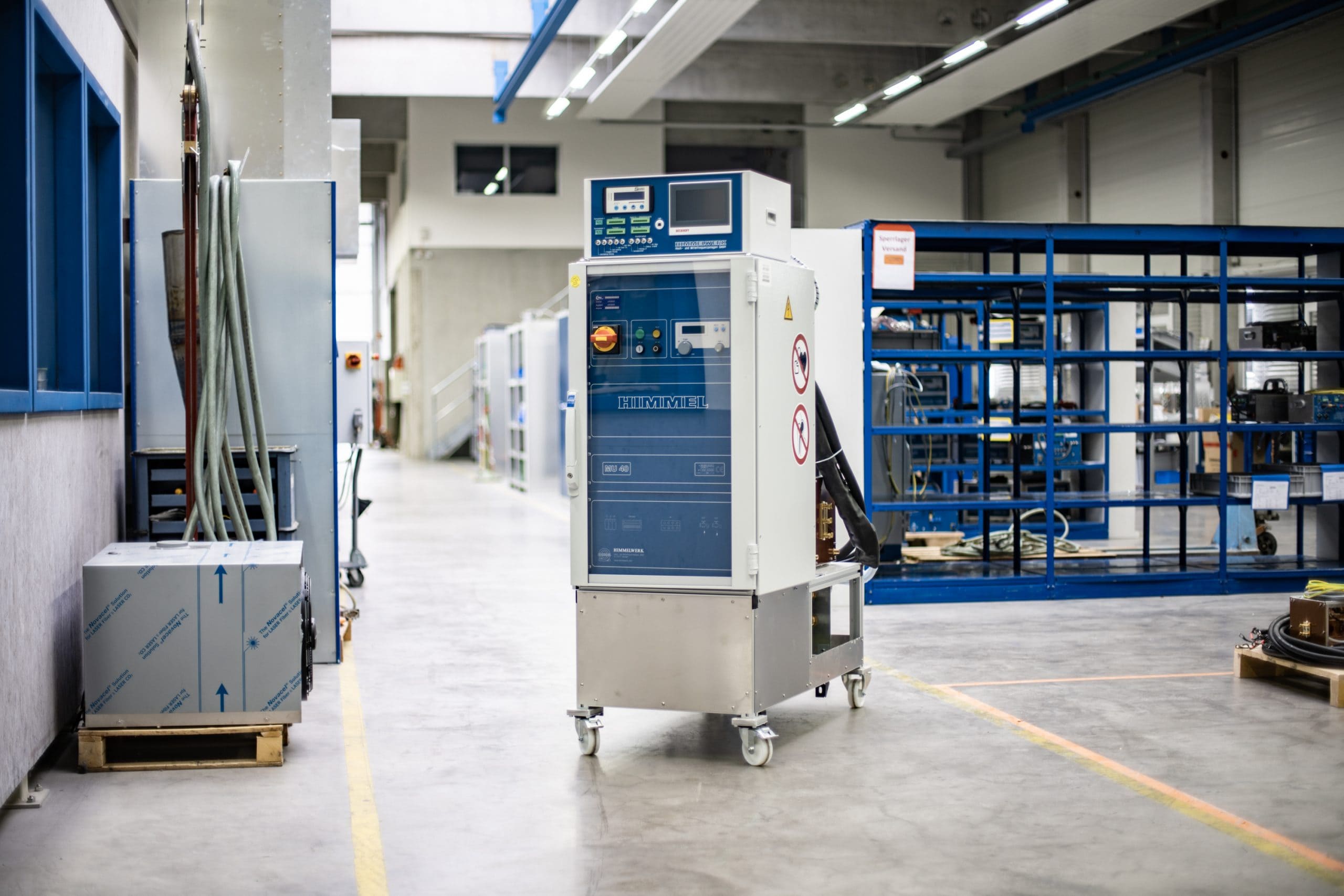
Benefits of quality monitoring

  • Intelligent detection in self-learning mode
  • Automatic termination of the induction process in the event of an error message
  • Part monitoring, even with very fast heating times of less than 100 ms
  • Intuitive operation and integrated temperature controller
  • Connection to all frequency converter series

Technical benefits

  • Improved networking possibilities through industrial interfaces
  • Device-dependent curve evaluation via fast control with cycle times from 40 ms
  • Optional addition of data logger
  • Optional addition of various bus systems

Smart Upgrade – the name says it all

S

as in: Self-learning mode

M

as in: Measure

A

as in: Analyse

R

as in: Relevant

T

as in: Tracking

In the self-learning mode, the Smart Upgrade measures all of the important process data and analyses them, thereby setting the relevant limit values. This is how smart part tracking works.

Himmelwerk IOT

This is how to upgrade with induction

Retrofitting your frequency converter with the Smart Upgrade is a process in which we provide you with professional support. This is where we explain the steps we are taking.

give us a call

Seit 1950 wurden von Himmelwerk 19.000 Hochfrequenz- und Mittelfrequenzgeneratoren in alle Welt verschickt.
Wie viel CO₂ sparen sie eigentlich pro Jahr ein? Eine Rechnung.

Annahme 1: 25 % der Generatoren sind noch in Betrieb.

Annahme 2: Sie haben im Durchschnitt eine Leistung von 6 kW und damit eine Leistungsaufnahme von 7 kW.

Annahme 3: Die Generatoren sind 8 Stunden/Tag und 5 Tage/Woche in Betrieb.

Annahme 4: Induktive Erwärmung spart bis zu 40 % Energie ein im Vergleich zu konventionellen Methoden. Gehen wir mal von 30 % aus.

Bei diesen Annahmen sieht die Rechnung so aus:

Täglicher Energieverbrauch: 8 h x 7 kW = 56 kW

Energieersparnis am Tag: 56 kWh / 0,7 = 80 kWh; 80 – 56 = 24 kWh

Gesamtersparnis am Tag: 24 kWh x 4.750 Generatoren = 114.000 kWh

Gesamtersparnis pro Jahr: 220 Arbeitstage x 114.000 kWh = 25.080.000 kWh

Umrechnungsfaktor kWh/CO₂: 1 kWh ≈ CO₂-Äquivalenzwert von 0,485 kg Strom (Quelle: Umweltbundesamt, Climate Change 15/2022)

CO₂-Einsparung pro Jahr: 25.080.000 kWh x 0,485 kg = 12.163.800 kg